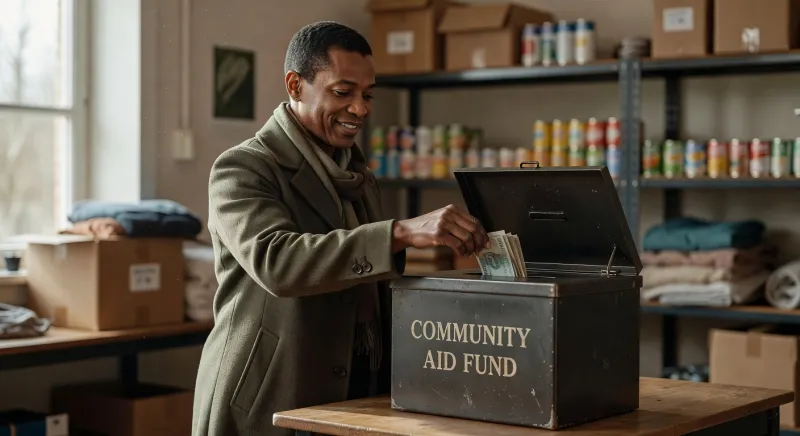
Before contracts, before currency, before the state, there was the gift. Not the wrapped-and-ribboned kind, but something far more consequential: the deliberate transfer of something valued from one person to another, with all the invisible threads of obligation, identity, and relationship that act sets in motion. Anthropologists studying gift exchange and social bonds have concluded, with remarkable consistency, that this simple act may be the foundational technology of human society itself — more structurally important than the wheel, more socially transformative than agriculture.
The Illusion of the 'Free' Gift
Most of us grow up with a romantic notion of gift-giving: it is spontaneous, generous, freely chosen. Anthropology quietly dismantles that idea — not to make giving seem cynical, but to reveal how much more powerful it actually is.
French sociologist Marcel Mauss published The Gift (Essai sur le don) in 1925, arguing that gift exchange in traditional societies was never purely voluntary but embedded in social obligation across three duties: giving, receiving, and reciprocating. This tripartite structure is the key insight. The gift is not a one-way act of generosity. It is the opening move in an ongoing relationship. To give creates an obligation in the receiver. To receive is to accept that obligation. To reciprocate is to keep the relationship alive and affirm its value. Refusing any part of this cycle — declining to give, rejecting a gift, or failing to return one — is not just rude. In many societies, it is a declaration of hostility or social withdrawal.

As an Amazon Associate, I earn from qualifying purchases.
Mauss drew on ethnographic data from societies across Melanesia, the Pacific Northwest of North America, and ancient Rome and India. What he found was not charity and not commerce, but a third thing entirely: a system in which objects moved through communities carrying social meaning that no price tag could capture. The gift, he argued, contains something of the giver — a Māori concept he called hau, the spirit of the thing given, which compels its eventual return.
The Kula Ring: Relationship as the Point
If Mauss gave us the theory, the Trobriand Islanders of the southwestern Pacific gave us the most vivid demonstration of it in action. Anthropologist Bronisław Malinowski documented the Kula ring exchange system among Trobriand Islanders, in which ceremonial objects — shell necklaces and armbands — were traded in a vast circular network across Pacific islands purely to create and sustain relationships, not for material utility.
The Kula ring spans hundreds of miles of open ocean. Men undertook dangerous voyages by outrigger canoe to exchange these objects with specific partners on other islands. Necklaces traveled clockwise around the ring; armbands traveled counterclockwise. Nobody kept these objects permanently. They were held for a time, admired, discussed, and then passed on. The practical value of a shell armband to a fisherman or farmer is essentially zero. That is precisely the point.
What the Kula ring produced was not wealth in any material sense. It produced relationships: named, durable, socially recognized partnerships between men on different islands who might otherwise be strangers or enemies. These partnerships, in turn, enabled the trade of genuinely useful goods, the resolution of disputes, the sharing of information about weather and navigation, and mutual protection. The ceremonial exchange was the scaffolding on which practical cooperation was built. The gift came first; everything useful followed.
As an Amazon Associate, we earn from qualifying purchases.
Mapping the Social Landscape: Three Kinds of Reciprocity
Not all giving is alike, and anthropologists have long recognized that the type of exchange that occurs between people is one of the clearest maps of the social distance between them. Marshall Sahlins, building on Mauss, distinguished between 'generalized reciprocity' (giving without expectation of return, typical within families), 'balanced reciprocity' (equal exchange between equals), and 'negative reciprocity' (attempting to get more than you give, typical between strangers or enemies).
This framework is quietly revelatory. Think about how you actually give to the people in your life. You feed your child without expecting to be fed in return. You might bring a friend a birthday gift and expect something comparable when your own birthday arrives. You bargain in a market with a stranger. Sahlins is pointing out that these are not merely different behaviors — they are expressions of fundamentally different social relationships, and the exchange itself both reflects and reinforces those relationships.
Generalized reciprocity is the grammar of intimacy. When you start keeping score with a close family member, something has gone wrong in the relationship, not in the accounting. Balanced reciprocity is the grammar of peer relationships — friendship, professional respect, community membership. Negative reciprocity marks the boundary of the social world: the space where trust has not yet been established, or has been broken.
Why Giving Builds Bonds More Than Receiving Does
Here is the counterintuitive finding that sits at the heart of the anthropological literature: it is the act of giving, not receiving, that most powerfully constructs and maintains social bonds. This runs against our ordinary intuitions. We tend to think that receiving a gift makes us feel connected to the giver. And it does. But the giver is transformed more.
When you give something — especially something that required thought, effort, or sacrifice — you have made an investment in another person. Psychologically and socially, this investment changes how you see them. They are now someone you have chosen, someone worth the cost. The gift externalizes your valuation of the relationship and makes it real in the world. It is also a commitment: you have signaled, publicly or privately, that this relationship matters to you.
Receiving, by contrast, creates obligation, which is not the same as warmth. The receiver must now decide what this gift means about the relationship, what is owed, and how to respond. The cognitive and emotional work of receiving is often heavier than we acknowledge. This is why unsolicited gifts from strangers can feel uncomfortable, and why gifts given with visible strings attached feel manipulative rather than generous — they weaponize the obligation structure of gift exchange.
The Gift in Modern Societies
It would be easy to assume that industrialized, monetized societies have somehow escaped the ancient logic of gift exchange — that we have rationalized our way out of it with salaries, contracts, and receipts. But the evidence says otherwise. The gift economy persists in modern life with extraordinary tenacity, operating in parallel with the market economy and governed by entirely different rules.
Consider the social choreography around occasions like weddings or birthdays. The objects exchanged at these events are often less important than the act of participation itself — showing up, acknowledging the moment, placing yourself visibly in the social network of the person being celebrated. A gift given at a wedding is not a transaction; it is an affiliation. You are declaring your membership in that couple's community.
The same logic governs the office gift exchange, the holiday meal cooked for neighbors, the flowers left on a colleague's desk after a hard week. None of these make strict economic sense. All of them make profound social sense. They are the ongoing maintenance work of human relationships — the regular deposits that keep social bonds from drying out.
Personalization as Social Signal
If the function of a gift is to communicate the value of a relationship, then the most socially potent gifts are those that demonstrate knowledge of the recipient — that you have paid attention, that you see them as an individual rather than a generic placeholder. This is why personalized gifts carry such disproportionate emotional weight relative to their material cost. They are proof of attention, which is itself a form of respect and care.
Mauss would recognize this immediately. The gift that contains something of the giver — their time, their observation, their effort — is exactly the kind of exchange his theory describes. It creates a stronger bond precisely because it is harder to reduce to a price. You cannot buy attentiveness off a shelf.
The Dark Side of Giving: When Gifts Dominate
The anthropological literature does not romanticize the gift. Mauss himself was acutely aware that gift exchange could be a vehicle for competition, domination, and coercion. The potlatch ceremonies of Pacific Northwest Indigenous peoples — in which leaders gave away or even destroyed vast quantities of wealth — were not purely generous acts. They were demonstrations of power. To give more than another chief could reciprocate was to publicly humiliate him and establish social hierarchy.
This dynamic survives in modern form. The overly lavish gift that the recipient cannot possibly match puts them in an uncomfortable position. Corporate gifts to politicians, gifts from employers to employees in contexts of unequal power — these operate in a space where the language of generosity is used to create and enforce obligation. Understanding the anthropology of gift exchange means recognizing both its warmth and its teeth.
What This Means for How We Give
Knowing that gift exchange is not merely a social nicety but a fundamental mechanism for building and sustaining human community changes how we might think about our own giving. It suggests that the ritual matters as much as the object — that showing up, acknowledging, and participating in exchange is doing real social work, not just going through the motions.
It also suggests that giving to people we do not yet know well — acts of generosity toward strangers, community members, or people in need — is not merely altruism. It is, in the deepest sense, an act of social construction. It is the opening move in a relationship that may or may not be reciprocated, but which expands the circle of who counts as part of your world.
A hundred years after Marcel Mauss sat down to write The Gift, and decades after Malinowski paddled (metaphorically) between the islands of the Kula ring, the evidence remains consistent: the most durable architecture of human society is not built from stone or steel or code. It is built from the repeated, obligation-laden, meaning-saturated act of one person offering something to another — and both of them knowing, in the wordless way that culture teaches, exactly what that means.
Sources
Every factual claim in this article was independently verified against the following sources:
- Gift economy — en.wikipedia.org
- Bronisław Malinowski — en.wikipedia.org
- Economic anthropology — en.wikipedia.org